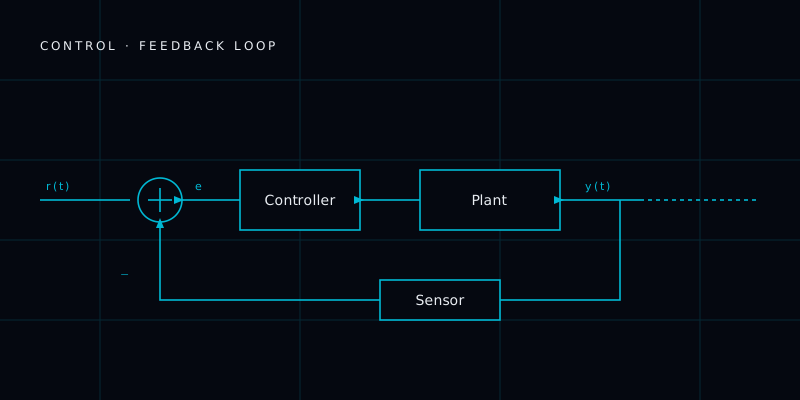
LQR is an optimal controller that computes the single best set of feedback gains by balancing how far the robot is from its target against how much effort the correction costs — the go-to method for balancing, hovering, and stabilizing robots.
LQR is a way to design a controller that automatically finds the best balance between correcting an error fast and not using too much energy or effort doing it. You tell it how much you care about each, and it computes the ideal feedback.
A PID controller is brilliant for one input and one output. But a self-balancing robot or a hovering drone has many coupled states — angle, angular rate, position, velocity — all interacting. For those, engineers reach for the Linear Quadratic Regulator.
What it is
LQR is an optimal controller. Given a linear model of the robot (ẋ = Ax + Bu), it computes the one set of feedback gains K that minimizes a cost function balancing two things you care about:
cost = Σ ( xᵀQx  +  uᵀRu )
         └ error ┘  └ effort ┘
Q says how much you dislike being away from the target (large Q → correct aggressively).
R says how much you dislike using control effort (large R → be gentle, save energy/actuators).
Solve the associated Riccati equation and out pops the optimal gain matrix. The controller is then simply u = -Kx.
LQR is optimal state feedback
K is computed once from the model and the Q/R weights. It reads the full state and produces the effort that optimally balances error against effort.
Why robots love it
LQR handles multi-input, multi-output systems naturally, where hand-tuning a web of PID loops would be a nightmare. Tuning becomes intuitive: instead of guessing gains, you set Q and R to express what you value, and the math finds the gains. It's the classic controller for cart-poles, Segways, quadrotor attitude, and legged-robot balancing.
The catch, and the sequel
LQR assumes a linear model and needs the full state. Real robots are nonlinear, so engineers linearize about an operating point (upright, hovering) — LQR then keeps you near that point beautifully but can't handle huge deviations. And if you can't measure every state, you pair LQR with a state observer or Kalman filter to estimate it (that combination is called LQG). When you also need to respect hard limits and look ahead, model predictive control generalizes the same optimal-cost idea across a future horizon.
Why it matters
LQR is the gateway from single-loop PID into modern optimal control. Understanding Q, R, and the state-feedback form is essential for anyone stabilizing a genuinely multi-variable robot.