A state observer estimates the internal states a robot can't directly measure — like velocity or load — by running a model in parallel and correcting it with the sensors it does have, so controllers get the full picture they need.
A state observer figures out things about a robot you can't measure directly — like how fast a joint is really moving — by running a simulation alongside the real robot and nudging it whenever the real sensors disagree.
Modern controllers like LQR want the robot's full state — position, velocity, and more. But sensors rarely give you everything: an encoder measures angle, not velocity; a joint feels position, not the external load. A state observer fills the gap.
The idea
Run a copy of the robot's model in software, driven by the same commands. That copy predicts what every state — including the hidden ones — should be. Then compare its predicted output to the real sensor reading. If they differ, the error nudges the estimate back toward reality:
The gain L sets how hard the observer trusts the sensor versus its own model.
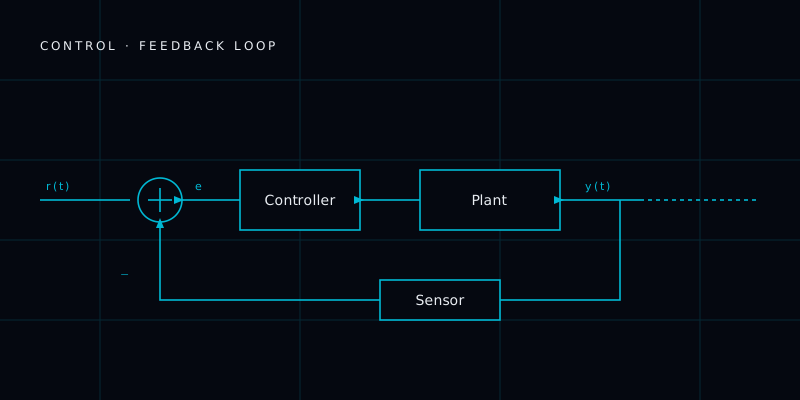
An observer runs a model and corrects it with sensors
The estimate feeds the controller as if it were the true state. The correction term keeps the software copy locked onto the real robot.
Observer vs Kalman filter
A basic (Luenberger) observer picks L for fast, stable convergence. The Kalman filter is the optimal observer for systems with Gaussian noise — it computes the best L (the Kalman gain) automatically from the noise statistics. Both do the same job: reconstruct hidden state. The Kalman filter just does it optimally when you know how noisy things are.
Where you'll see it
Sensorless motor control estimates rotor position without a dedicated sensor. Drones estimate velocity and wind disturbance they never directly measure. Manipulators estimate external contact force from motor currents (a "disturbance observer"). Pairing an observer with LQR gives the classic LQG controller — estimate the state, then feed it back optimally.
Why it matters
You can't control what you can't see. Observers are how robots act on states no sensor reports — turning a partial view of the world into the full picture a good controller needs.