Closed-loop control
456 words · 3 min read · 2 sources
Closed-loop control uses sensor feedback to continuously compare what a robot is doing with what it should be doing, then adjusts its output to close the gap — making robots accurate even when conditions change.
A cyclist riding with their eyes open and a cyclist riding blindfolded are doing very different things. Eyes open, they see the kerb approaching, steer away from it, check they've moved enough, and correct again — thousands of micro-adjustments per second. Eyes closed, they pedal and hope. The cyclist with eyes open is running a closed-loop system. The one w
A cyclist riding with their eyes open and a cyclist riding blindfolded are doing very different things. Eyes open, they see the kerb approaching, steer away from it, check they've moved enough, and correct again — thousands of micro-adjustments per second. Eyes closed, they pedal and hope. The cyclist with eyes open is running a closed-loop system. The one who is blindfolded is running open-loop.
The difference is feedback: information that flows back from the world into the decision-making process.
The feedback loop explained
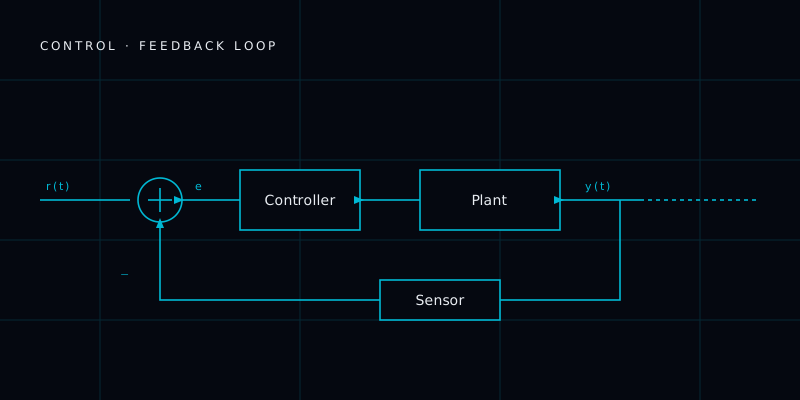
A closed-loop control system has four parts working in a cycle:
- Reference — the desired state (target speed, target angle, target temperature).
- Sensor — a device measuring the actual current state.
- Controller — compares reference against actual, computes the error, decides how to correct.
- Actuator — applies the correction (motor, valve, heater).
Then the sensor measures again, the controller compares again, and the cycle repeats — dozens to thousands of times per second. Because the loop closes back on itself, any disturbance that pushes the system off target gets detected and corrected automatically.
A concrete example: a robotic arm joint
A robotic arm from KUKA or Fanuc needs to move its elbow joint to exactly 47 degrees. An encoder — a sensor that counts tiny notches on a rotating disc — reports the current angle 1,000 times per second. If the joint reaches only 44 degrees (perhaps because a heavy payload resisted), the controller detects the 3-degree error and applies more motor current. When the encoder reports 47 degrees, the controller reduces current to hold position. If the arm is nudged by a worker, the system corrects back within milliseconds. The arm doesn't "know" about the disturbance; it simply keeps closing the gap.
Why closed-loop control changed robotics
Open-loop systems are fine until something unexpected happens. Manufacturing, surgery, and autonomous driving are full of unexpected things: varying loads, temperature changes, wear, uneven terrain. Closed-loop control makes a robot robust to those surprises. A surgical robot using closed-loop force control can detect the resistance of tissue and stop before cutting too deep. A self-driving car using closed-loop steering can hold a lane even as crosswinds push it sideways.
The cost is complexity: you need sensors, and sensors can fail. You also have to tune the controller carefully — too aggressive a correction and the system oscillates; too timid and it responds slowly. This is precisely what PID controllers and more advanced methods like model-predictive control are designed to handle.
Almost everything precise in modern engineering — from a phone's image stabiliser to a nuclear plant's cooling system — runs a closed feedback loop of some kind.
Ask R2 Co-pilot anything you didn't understand about Closed-loop control. It'll explain it plainly.
Keep going
3D Gaussian Splatting
3D Gaussian splatting represents a scene as millions of tiny colored blobs, rendering photorealistic 3D in rea…
Concept6D Pose Estimation
6D pose estimation figures out an object's full position and orientation in 3D from a camera — not just where …
ConceptA* (A-Star) Pathfinding
A* finds the shortest path between two points on a grid or graph. It is the most-used pathfinding algorithm in…
Last updated · 2026-05-19
Community discussion
0 questions & insightsLoading discussion…
Spotted something off? Report an error →