Feedback Loop in Robotics
215 words · 2 min read · 1 source
A feedback loop continuously measures a robot's output and adjusts its input to reach a desired target. It is the most fundamental control concept in all of robotics.
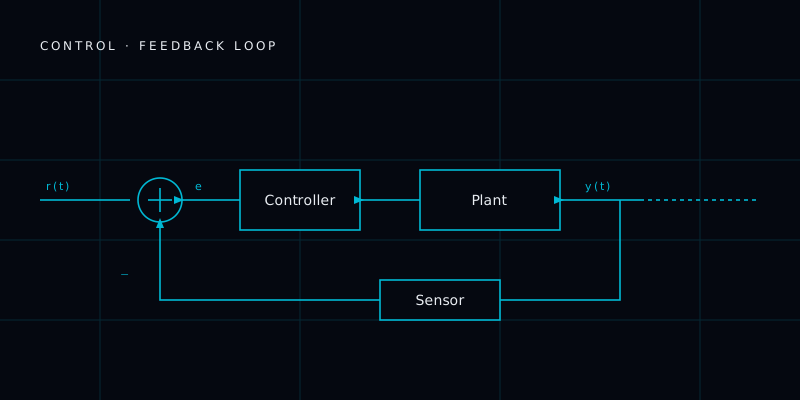
A feedback loop is a control structure where the system measures its own output, compares it with a target (the setpoint), computes the error, and feeds that error back into the input to drive the output toward the target. It's the backbone of every stable robotic system.
What is it?
A feedback loop is a control structure where the system measures its own output, compares it with a target (the setpoint), computes the error, and feeds that error back into the input to drive the output toward the target. It's the backbone of every stable robotic system.
How it works
The loop has four parts: a sensor that measures the actual output, a comparator that subtracts measured from desired to compute error, a controller (often PID) that converts error into a command, and an actuator that applies the command. The cycle repeats continuously — typically hundreds to thousands of times per second — until the error is near zero.
Real-world example
A cruise-control system in a car is a feedback loop — measure speed, compare to setpoint, adjust throttle. A robotic arm holding position uses feedback at each joint. A Roomba's wall-following is a feedback loop based on side-sensor distance.
Why it matters for robotics
Open-loop systems blow up under disturbance; feedback loops self-correct. Mastering feedback is the difference between a robotics hobbyist and an engineer. Every PID tuner, ROS2 control node, and DRDO Daksh stabiliser is a feedback loop in disguise.
See also
Next: one minute
Watch how Feedback Loop in Robotics actually works
A one-minute video, an interactive demo you can poke at, and one question to check it landed.
Watch the one-minute lesson →Plain English. Free. Unsubscribe in one click.
Learn this in the Academy
⚡S-05: The Robot Brain
Hands-on lesson · Spark track
Keep going
PID controller
A PID controller is a feedback algorithm that continuously corrects a robot's behaviour by measuring the gap b…
ConceptClosed-loop control
Closed-loop control uses sensor feedback to continuously compare what a robot is doing with what it should be …
ConceptFeedback
Feedback is the mechanism by which a system uses information about its own output to correct its future behavi…
Last updated · 2026-05-21
Spotted something off? Report an error →