Cascade Control in Robotics
198 words · 1 min read · 1 source
Cascade control uses two nested feedback loops — an inner fast loop for the actuator and an outer slow loop for the high-level goal — to deliver fast, stable response.
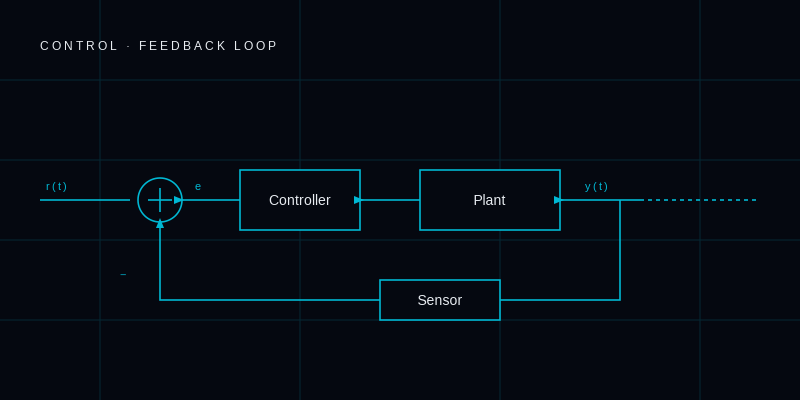
Cascade control is a control architecture with two nested feedback loops. The inner loop runs fast and regulates a primary variable (such as motor current or velocity); the outer loop runs slower and sets the setpoint for the inner loop based on a higher-level goal (such as position).
What is it?
Cascade control is a control architecture with two nested feedback loops. The inner loop runs fast and regulates a primary variable (such as motor current or velocity); the outer loop runs slower and sets the setpoint for the inner loop based on a higher-level goal (such as position).
How it works
The outer controller compares the desired output (e.g., joint position) with the measured output and produces a setpoint for the inner controller (e.g., desired velocity). The inner controller then closes the loop on velocity using current feedback. The inner loop is typically 5–10× faster than the outer, so disturbances are rejected quickly before they propagate.
Real-world example
Industrial robot arms almost universally use cascade control — current loop at 20 kHz, velocity loop at 2 kHz, position loop at 200 Hz. Pressure-controlled hydraulic systems use cascade with pressure-inside-flow loops.
Why it matters for robotics
Cascade control delivers faster response and better disturbance rejection than a single-loop PID, especially when the actuator dynamics are slow. Understanding cascade is essential before working on real motion-control systems.
See also
Next: the course path
Five free courses, from zero to your own robot design
Short videos with a quiz after each one, a final activity and a certificate per course.
See the course path →Plain English. Free. Unsubscribe in one click.
Keep going
Feedback Loop in Robotics
A feedback loop continuously measures a robot's output and adjusts its input to reach a desired target. It is …
ConceptPID controller
A PID controller is a feedback algorithm that continuously corrects a robot's behaviour by measuring the gap b…
ConceptClosed-loop control
Closed-loop control uses sensor feedback to continuously compare what a robot is doing with what it should be …
Last updated · 2026-05-21
Spotted something off? Report an error →