The spring-mass-damper is the simplest model of a vibrating, settling system — three elements that capture how almost any robot joint or structure responds to a disturbance, and the mental model behind impedance control and tuning.
A spring-mass-damper is a weight on a spring with a shock absorber. Push it and it bounces back and settles. This tiny model describes how almost any robot part reacts to being disturbed — whether it wobbles or settles smoothly.
If you understand one dynamic system, make it the spring-mass-damper — because almost every robot joint, structure, and control loop behaves like one. It's the single most useful mental model for how things vibrate and settle.
The three elements
Picture a mass on a spring with a damper (shock absorber):
Mass (m) — resists acceleration (inertia).
Spring (k) — provides a restoring force pulling it back toward rest (stiffness).
Displace the mass and release it: the spring pulls it back, the mass overshoots, the damper bleeds energy, and it eventually settles. This "second-order system" has a characteristic response captured by two numbers: its natural frequency (how fast it oscillates) and its damping ratio (how quickly oscillations die out).
Disturb, oscillate, settle
The interplay of inertia, stiffness, and damping decides whether the response is a smooth settle or a ringing wobble — the essence of second-order dynamics.
Why it's everywhere in robotics
Every joint is one. A robot joint with its motor stiffness and inertia, plus friction/damping, behaves as a spring-mass-damper. Its natural frequency and damping determine whether it settles cleanly or oscillates.
Impedance control. A robot rendered "soft" behaves as a programmable spring-mass-damper — you literally set its virtual stiffness and damping. Understanding this model is understanding impedance/admittance control.
Series-elastic actuators and legged robots deliberately introduce springs and dampers, tuned via this model.
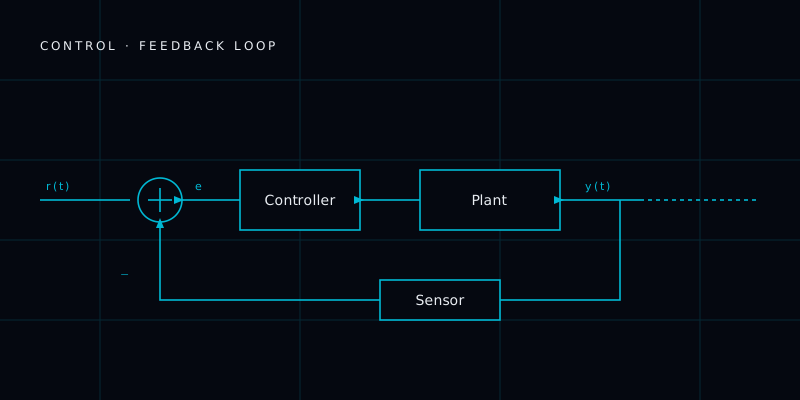
Control tuning. A PID loop closed around a system makes it behave like a second-order spring-mass-damper — the "P" gain acts like stiffness, "D" like damping. Tuning is choosing the response.
Vibration and structures. Flexible robot links, suspensions, and mounts are analyzed this way.
The universal insight
Because so much reduces to this model, its two parameters tell you the response type:
Underdamped — oscillates before settling (fast but wobbly).
Critically damped — settles fastest without oscillating (often the goal).
Overdamped — settles slowly without overshoot (sluggish).
Choosing where a robot sits on this spectrum — via stiffness and damping — is a core design and control decision.
Why it matters
The spring-mass-damper is the Rosetta Stone of dynamic behavior in robotics: master it and you understand how joints respond, how impedance control works, how PID tuning shapes motion, and why things oscillate or settle. It's the simplest model that explains an enormous amount of real robot behavior.