Impedance Control in Robotics — Complete Guide | R2BOT
320 words · 2 min read
Impedance control makes a robot behave like a programmable spring-damper — essential for safe contact, manipulation, and human-robot interaction.
Impedance control programs a robot's joints to respond to external forces like a virtual spring-damper system. Push the robot and it pushes back gently; release it and it returns to position. It is the control technique that makes cobots safe to touch and surgical robots feel natural.
Impedance Control in Robotics
What is Impedance Control in Robotics?
Impedance control programs a robot's joints to respond to external forces like a virtual spring-damper system. Push the robot and it pushes back gently; release it and it returns to position. It is the control technique that makes cobots safe to touch and surgical robots feel natural.
How It Works
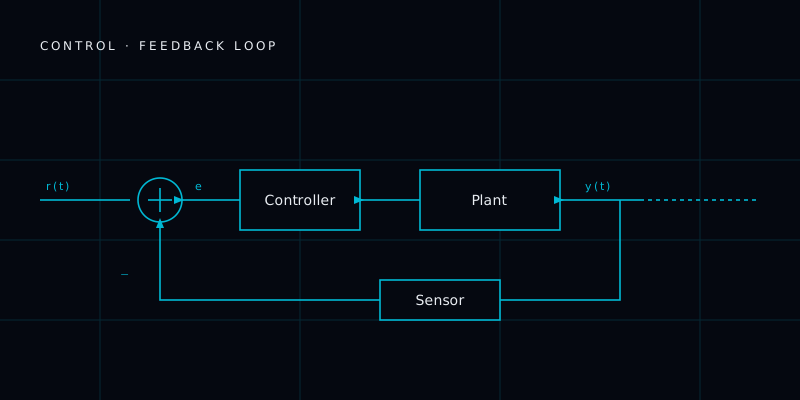
Instead of commanding a position and resisting any disturbance (stiff position control), impedance control sets a desired mechanical impedance — virtual stiffness, damping, and inertia — between the robot's tool and the world. The controller measures actual deflection and joint torque, then commands motor currents so the robot's apparent dynamics match the desired spring-damper model. This requires torque-controllable actuators or accurate joint-torque sensors.
Real-World Example
Universal Robots cobots use joint-level impedance control to stop on contact. Franka Emika Panda's torque-sensing joints make impedance control its default mode. Surgical robots use impedance control to let the surgeon feel tissue resistance. Indian academic groups at IIT Madras and IISc develop impedance-controlled prosthetics.
Why It Matters for Robotics
Without impedance control, a robot is either rigid (and dangerous in contact) or floppy (and useless for precision). Programmable compliance is the foundation of safe human-robot interaction and dexterous manipulation — both major hiring areas globally.
Try It Yourself
On a 7-DOF manipulator simulator (e.g., the Franka Panda in Gazebo), enable impedance mode and "drag" the robot end-effector. Adjust the stiffness K and damping D and feel how the robot behaves — it really does respond like a programmable spring.
Quick Quiz
Quick Quiz
3 questions
1.Impedance control makes the robot behave like a:
2.Impedance control is essential for which scenario?
3.Implementing impedance control usually requires:
Further Reading
Ask R2 About This
Open the R2 Co-pilot (press ⌘K anywhere on R2BOT) and ask: "Explain Impedance Control in Robotics for a Class 9 student in India, with one real-world Indian example." You'll get a tailored, sourced answer in seconds.
🐍 Python Playground · runs in your browser
Editor · 15 lines
Output
Press ▶ Run to execute. First run downloads Python (~6MB) — only happens once per page.
Powered by Pyodide · Python in WebAssembly · no server required.
Ask R2 Co-pilot anything you didn't understand about Impedance Control in Robotics — Complete Guide | R2BOT. It'll explain it plainly.
Keep going
Cobot (collaborative robot)
A cobot is a robotic arm designed to share workspace safely with humans. Soft joints, force sensors, and slow …
ConceptCollaborative Robot (Cobot) Safety — Complete Guide
Cobots work alongside humans without cages. Safety relies on force limiting, speed monitoring, and ISO/TS 1506…
ConceptFeedback Loop in Robotics — Complete Guide
A feedback loop continuously measures a robot's output and adjusts its input to reach a desired target. It is …
Last updated · 2026-05-21
Community discussion
0 questions & insightsLoading discussion…
Spotted something off? Report an error →