Damping ratio measures how quickly a system's oscillations die out — the single number that decides whether a robot joint settles crisply, overshoots and rings, or crawls to its target, and a central knob in control tuning.
Damping ratio says how bouncy or how sluggish a system is. Low damping means it overshoots and wobbles a lot; high damping means it settles slowly with no bounce. Just right and it settles fast and clean — the sweet spot for a robot joint.
Command a robot joint to a target and it might snap there and ring, glide in smoothly, or sluggishly creep. Which one happens is set by the damping ratio — the number that governs how oscillations die out, and a central dial in every control loop.
What it is
Damping ratio (ζ, "zeta") is a dimensionless measure of how quickly a disturbed system's oscillations decay. Together with natural frequency, it fully describes a second-order (spring-mass-damper) system's response. It divides behavior into three regimes:
Underdamped (ζ < 1) — oscillates, overshooting the target and ringing before settling. Fast but wobbly.
Critically damped (ζ = 1) — the sweet spot: reaches the target in the shortest time with no overshoot.
Overdamped (ζ > 1) — no oscillation, but settles slowly. Safe but sluggish.
How the oscillations die out
Damping ratio sets the character of the settling response. Critical damping is often ideal; underdamped is faster but risks overshoot; overdamped is safe but slow.
Why it's a key control decision
Overshoot vs speed. For a robot placing a part or a drone holding altitude, overshoot can be unacceptable (it slams past the target) — so you want ζ ≥ 1. For other tasks a little overshoot buys speed. Choosing ζ is choosing this trade-off.
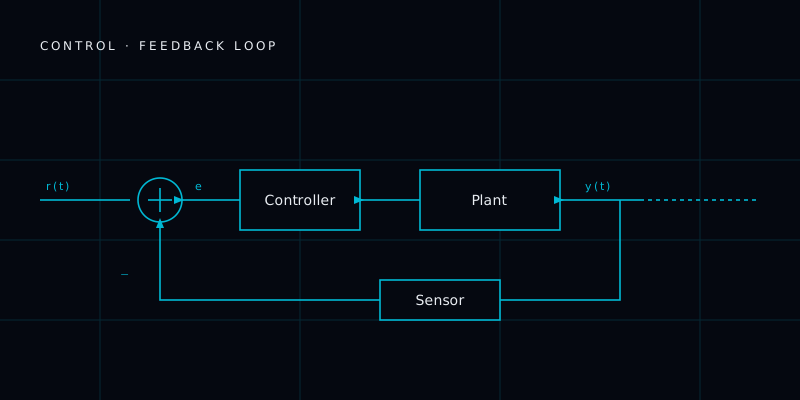
PID tuning. In a PID loop, the derivative (D) term adds damping. Too little D and the joint overshoots and rings (underdamped); too much and it becomes sluggish (overdamped). Tuning D is largely dialing in the damping ratio, while P sets the natural frequency.
Comfort and wear. Underdamped motion vibrates, stresses mechanisms, and feels jerky; well-damped motion is smooth and easy on hardware (related to why jerk-limited profiles matter).
Real limits. Achievable damping is bounded by friction, sensor noise (which the D term amplifies), and mechanical resonances.
The practical target
Many robot controllers aim for a damping ratio a little below critical (ζ ≈ 0.7) — this gives a fast response with only slight, quickly-dying overshoot, often the best balance of speed and settling for precise motion. But the "right" ζ depends entirely on whether overshoot is tolerable.
Why it matters
Damping ratio is one of the two numbers (with natural frequency) that define how any robot joint or control loop responds to commands — and it's the one you most directly tune to trade overshoot against speed. Understanding it is essential to control tuning, motion quality, and diagnosing why a robot wobbles or drags to its target.