Feedforward Control in Robotics — Complete Guide
192 words · 1 min read
Feedforward control predicts the disturbance or load on a robot and pre-compensates for it, instead of waiting to react. Used with feedback for high-performance motion.
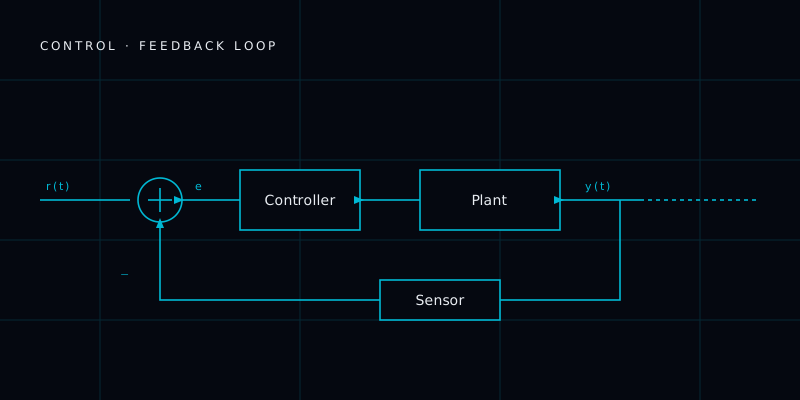
Feedforward control is a strategy where the controller adds an a-priori command based on a model of the system's expected behaviour — so the robot doesn't have to wait for an error before acting. It is the natural complement to feedback.
Feedforward Control in Robotics
What is it?
Feedforward control is a strategy where the controller adds an a-priori command based on a model of the system's expected behaviour — so the robot doesn't have to wait for an error before acting. It is the natural complement to feedback.
How it works
A feedforward term is calculated from a known model — for example, the gravity torque on each joint of a robotic arm. The controller adds this term to the feedback-driven correction. The combined command moves the actuator more accurately because most of the load is already cancelled before any error appears.
Real-world example
When Boston Dynamics Atlas lifts a heavy box, a feedforward term anticipates the load and pre-energises the relevant joint motors. Cruise control adds feedforward when it detects an incline. Industrial paint robots compensate for spray-nozzle inertia with feedforward.
Why it matters for robotics
Feedforward dramatically improves tracking accuracy and reduces lag. It's a recurring topic in robotics interviews — and the secret behind why high-end robots feel so much smoother than DIY ones.
See also
Ask R2 Co-pilot anything you didn't understand about Feedforward Control in Robotics — Complete Guide. It'll explain it plainly.
Keep going
Feedback Loop in Robotics — Complete Guide
A feedback loop continuously measures a robot's output and adjusts its input to reach a desired target. It is …
ConceptModel Predictive Control (MPC) in Robotics — Complete Guide
MPC predicts future robot behaviour over a horizon and solves an optimisation problem to choose the best contr…
ConceptPID controller
A PID controller is a feedback algorithm that continuously corrects a robot's behaviour by measuring the gap b…
Last updated · 2026-05-21
Community discussion
0 questions & insightsLoading discussion…
Spotted something off? Report an error →