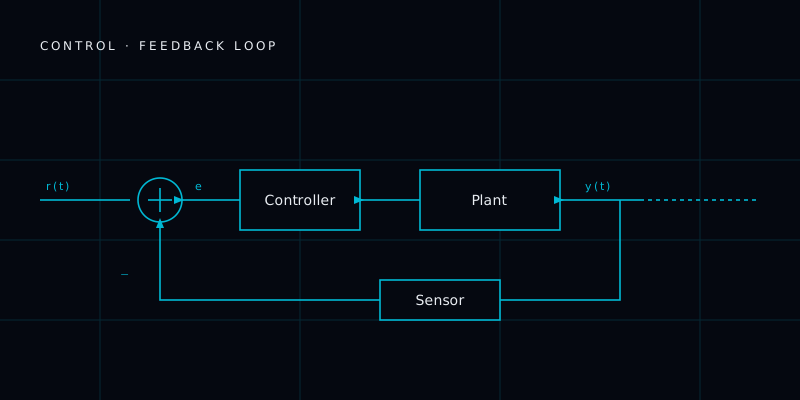
Feedback linearization is a control trick that cancels a system's nonlinearities with math, transforming a hard nonlinear robot into an easy linear one so standard linear controllers can take over.
Feedback linearization cancels the messy, nonlinear parts of a system using the system's own model, so what's left behaves like a simple straight-line system that ordinary controllers already handle well.
Most control theory — PID, LQR, pole placement — assumes a linear system. Real robots are stubbornly nonlinear. Feedback linearization bridges that gap by cancelling the nonlinearity in software.
The idea
If you know a system's nonlinear dynamics, you can design a control input that exactly cancels the nonlinear terms, leaving behind a clean linear relationship between a new "virtual" input and the output. Then you control that easy linear system with any standard method.
Cancel the nonlinearity, then control linearly
The inner law flattens the nonlinear dynamics into a straight line; the outer linear controller then does the actual tracking.
Computed torque control for robot arms is the most famous special case: cancelling gravity, inertia, and coupling is exactly feedback linearization applied to a manipulator.
Two flavors
Input-output linearization makes a chosen output behave linearly (e.g. the end-effector position).
Full-state linearization transforms the entire state dynamics.
A subtlety: cancelling the output dynamics can leave hidden internal dynamics running underneath (the "zero dynamics"). If those are unstable, the visible output looks perfect while something inside quietly diverges — a classic trap the control engineer must check.
Strengths and limits
When the model is good, feedback linearization gives exact, global linear behavior — far beyond what linearizing "about a point" achieves. But it leans entirely on the model: unmodeled friction, flexing, or payload leaves the cancellation imperfect. That's why it's often paired with robust or adaptive terms — or why some engineers prefer sliding mode control, which tolerates model error by design.
Why it matters
Feedback linearization is the key conceptual tool for controlling nonlinear robots with linear methods. Understanding it unlocks manipulator control, and it's the theory behind the computed-torque and whole-body controllers that make modern arms and humanoids move precisely.