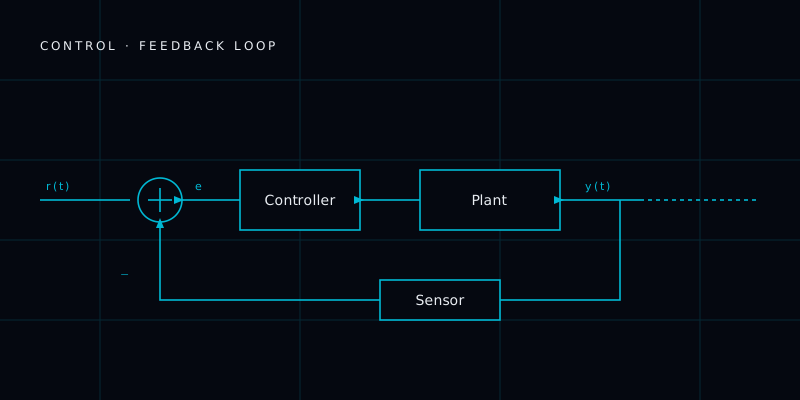
Computed torque control uses a robot's own physics model to cancel its nonlinear dynamics — gravity, inertia, and coupling — so a simple linear controller can drive each joint precisely, the backbone of high-performance arm control.
Computed torque control uses the robot's known physics to predict exactly how much torque each joint needs to fight gravity and inertia, then adds a small correction on top. By cancelling the hard nonlinear part, the leftover control is easy.
A heavy robot arm is a nightmare for a plain PID controller: gravity pulls harder when it's outstretched, one joint's motion flings the others around, and effective inertia changes with every pose. Computed torque control tackles this head-on — by doing the physics.
The idea
A manipulator's dynamics are known (from its URDF and mass properties):
Computed torque control simply computes the torque that model demands to follow the desired motion — cancelling gravity, inertia, and coupling — and adds a small feedback correction (usually PD) to mop up modeling error:
τ = M(θ)·(θ̈_desired + Kp·e + Kd·ė) + C·θ̇ + g(θ)
Cancel the hard part, then control the easy part
The model term does the heavy lifting (feedforward); the small PD term corrects whatever the model got slightly wrong.
Why it works so well
Once the nonlinear terms are cancelled, every joint behaves like a simple, decoupled linear system — so a basic PD law delivers crisp, uniform tracking across the whole workspace, not just near one tuned pose. It's essentially feedforward from physics plus light feedback.
The catch
The method is only as good as the model. Unknown payloads, friction, and flexible links all leave residual error — which is why the feedback term stays, and why adaptive versions estimate uncertain parameters online. It also needs joint accelerations and a fast torque-controlled actuator, so it's most at home on research arms and torque-controlled robots rather than cheap position-only servos.
Why it matters
Computed torque control is the classic bridge between robot dynamics and robot control. It's why a well-modeled arm can move fast and accurately everywhere in its workspace, and it underpins the whole-body controllers on modern humanoids.