Convolutional Neural Network (CNN) in Robotics — Complete Guide | R2BOT
337 words · 2 min read
CNNs are the workhorse neural architecture for robot vision. They power object detection, segmentation, and depth prediction in every modern robot.
A Convolutional Neural Network (CNN) is a type of neural network designed for processing images. It uses learnable filters that slide across an image, detecting edges, textures, and shapes — and combining these into high-level features like 'person', 'wheel', or 'apple'. CNNs are the foundation of nearly all modern robot vision.
Convolutional Neural Network (CNN) in Robotics
What is Convolutional Neural Network (CNN) in Robotics?
A Convolutional Neural Network (CNN) is a type of neural network designed for processing images. It uses learnable filters that slide across an image, detecting edges, textures, and shapes — and combining these into high-level features like 'person', 'wheel', or 'apple'. CNNs are the foundation of nearly all modern robot vision.
How It Works
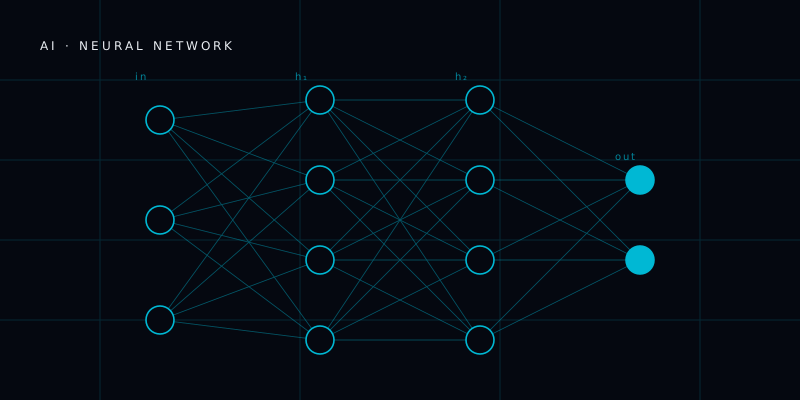
A CNN stacks convolutional layers, each containing many learnable filter kernels (e.g., 3×3). Each filter convolves across the input, producing a feature map highlighting where its pattern appears. Pooling layers downsample, building larger receptive fields. Activation functions (ReLU) add nonlinearity. After many stages, fully connected layers turn the feature maps into class scores or bounding boxes. CNNs are trained by gradient descent on labelled data; modern training relies on GPUs and frameworks like PyTorch.
Real-World Example
YOLO (You Only Look Once) is a CNN that powers real-time object detection in drones, autonomous cars, and warehouse robots. NVIDIA Jetson devices run CNNs at 30+ FPS for on-robot perception. Tesla's vision stack used CNN-only architectures for years; Indian agritech startups (Niqo Robotics, Cropin) use CNNs to detect diseased crops.
Why It Matters for Robotics
CNNs were the breakthrough that made robot vision practical. Every robotics-CV role today expects CNN fluency: training, fine-tuning, deploying on edge devices. Indian engineering schools have entire courses dedicated to CNNs.
Try It Yourself
Open Google Colab. Train a simple CNN on the MNIST handwritten digits dataset using PyTorch in 30 lines. Achieve 98%+ accuracy in 5 minutes. Then port it to a Raspberry Pi to recognise digits from your phone's camera.
Quick Quiz
Quick Quiz
3 questions
1.CNNs are primarily designed for:
2.A typical CNN layer applies:
3.YOLO is a famous example of a:
Further Reading
Ask R2 About This
Open the R2 Co-pilot (press ⌘K anywhere on R2BOT) and ask: "Explain Convolutional Neural Network (CNN) in Robotics for a Class 9 student in India, with one real-world Indian example." You'll get a tailored, sourced answer in seconds.
🐍 Python Playground · runs in your browser
Editor · 15 lines
Output
Press ▶ Run to execute. First run downloads Python (~6MB) — only happens once per page.
Powered by Pyodide · Python in WebAssembly · no server required.
Ask R2 Co-pilot anything you didn't understand about Convolutional Neural Network (CNN) in Robotics — Complete Guide | R2BOT. It'll explain it plainly.
Keep going
Computer vision (for robots)
Computer vision is how a robot makes sense of what its camera sees. It turns pixels into objects, distances, a…
ConceptNeural network
A neural network is a mathematical system loosely inspired by the brain, made of layers of simple calculations…
ConceptObject detection
Object detection is an AI task where a computer identifies what objects are present in an image and draws a bo…
Last updated · 2026-05-21
Community discussion
0 questions & insightsLoading discussion…
Spotted something off? Report an error →