Computer vision (for robots)
839 words · 5 min read · 2 sources
Computer vision is how a robot makes sense of what its camera sees. It turns pixels into objects, distances, and decisions — and it's done a lot more of the heavy lifting in modern robotics than you'd guess.
Computer vision is how a robot makes sense of what its camera sees. It turns a flat grid of pixels into "there's a person 3 metres ahead, facing me, walking forward at 1 m/s." It's done a lot more of the heavy lifting in modern robotics than you'd guess.
🇮🇳 In India
Cropnosis, an Indian startup, uses computer vision on drone footage to detect crop diseases before they spread — saving lakhs of rupees per farm.
Why it matters
Without computer vision (for robots), many concept systems in robotics simply couldn't work.
🤯 A state-of-the-art vision model can classify 1,000 object categories in under 1 millisecond. A human takes ~100 ms to consciously identify an object.
🎯 Quick challenge
What neural network architecture revolutionised computer vision in 2012?
Computer vision is how a robot makes sense of what its camera sees. It turns a flat grid of pixels into "there's a person 3 metres ahead, facing me, walking forward at 1 m/s." It's done a lot more of the heavy lifting in modern robotics than you'd guess.
The five jobs computer vision does for robots
Classification. "What is this thing?" — given a picture, output a label: dog, traffic light, screwdriver.
Detection. "Where is the thing?" — given a picture, output a bounding box around every object of interest plus its label.
Segmentation. "Which pixels are the thing?" — given a picture, output a precise outline of every object, pixel-perfect.
Depth estimation. "How far is the thing?" — given a picture (or two from stereo cameras), output a depth map.
Tracking. "Where is the same thing going?" — given a sequence of pictures, follow each object frame by frame.
Most robot vision pipelines chain these together: detect objects → estimate their depth → track their motion → decide what to do.
How it actually works today
Until ~2012, computer vision was hand-engineered: humans wrote rules ("if the pixels here are dark and edge-aligned, it's probably a road"). It mostly didn't work.
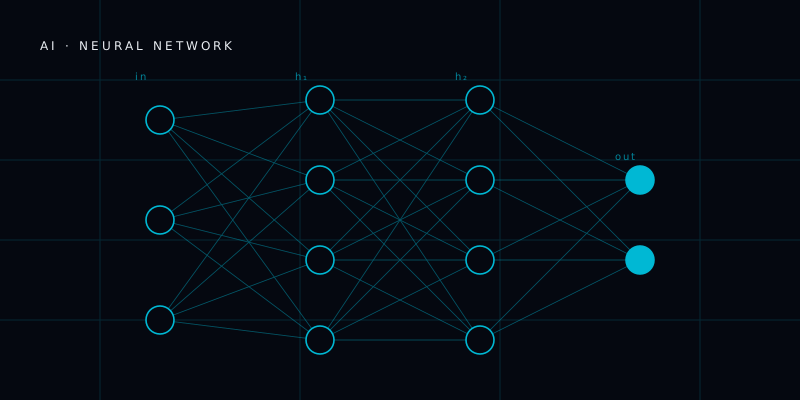
After 2012 (the AlexNet moment), the field switched to convolutional neural networks (CNNs). You feed millions of labelled pictures to a network. The network learns the features on its own.
After 2021, transformer-based vision models (ViT, DINO, SAM) became state of the art. These can be trained on much larger, less-labelled datasets, and they generalise better.
A modern robot like Optimus or Figure 03 has a single neural network that does detection, segmentation, depth, and tracking in one pass — at 30 frames per second, running on a few-hundred-watt onboard computer.
Tesla vs. Waymo — the classic vision debate
Tesla uses vision-only self-driving: just cameras, no lidar, no radar.
Waymo uses sensor fusion: cameras plus lidar plus radar.
Tesla's argument: humans drive with just two cameras (eyes), so cars should be able to. Waymo's argument: cars don't need to be limited to human senses — give them lidar too and they're safer.
Neither approach is finished. The argument is one of the biggest open questions in modern robotics.
The models an engineer actually reaches for
- Detection: the YOLO family (v8/v11) — one forward pass, real-time on an onboard GPU — is the default for robots that must react at 30–60 fps. Two-stage detectors (Faster R-CNN) are more accurate but slower.
- Segmentation: Mask R-CNN for instance masks; SAM / SAM 2 (Segment Anything) for promptable, zero-shot masks that generalize to objects never seen in training — a big deal for open-world manipulation.
- Backbones: CNNs (ResNet, EfficientNet) still win on tiny edge budgets; Vision Transformers (ViT, DINOv2) win when you have data and compute, and their features transfer better to downstream robot tasks.
- Depth: stereo matching, or monocular depth models (Depth Anything) when you only have one camera.
How vision quality is measured
You can't tune what you can't score. The core metric is IoU (Intersection over Union) — overlap between predicted and true boxes/masks. Detection is summarized by mAP (mean Average Precision) across IoU thresholds, the number every benchmark (COCO) reports. For a robot, though, the metric that matters is often downstream: did the grasp succeed? A model with high mAP can still fail the robot if it's wrong on the specific objects and lighting the robot faces.
Why robot vision is harder than benchmark vision
A model that scores well on internet photos can fall apart on a robot because of the domain gap: motion blur, odd viewpoints, harsh or changing lighting, transparent/reflective objects (glass, metal), and cluttered scenes with heavy occlusion. Two consequences dominate real deployments — models trained in simulation need domain randomization to survive the sim-to-real jump, and latency is a hard constraint: a perfect detection that arrives 200 ms late is useless to a moving robot. This is why perception is co-designed with control, not bolted on.
Check your understanding
1. What's the difference between object detection and segmentation? Detection outputs a bounding box + label per object; segmentation outputs a per-pixel mask — a precise outline. Segmentation is heavier but essential for grasping oddly-shaped objects.
2. A detector scores high mAP on COCO but the robot keeps mis-grasping — what's likely wrong? The domain gap: the robot's lighting, viewpoints, motion blur, or object set differ from the benchmark data. Benchmark accuracy doesn't guarantee task success.
3. Why might you pick YOLO over Faster R-CNN on a mobile robot? YOLO is single-stage and real-time; on a latency-constrained robot a slightly-less-accurate detection at 60 fps beats a more accurate one that arrives too late to act on.
The first practical use of computer vision most people have touched is the Roomba's navigation cameras. Read How a Roomba decides where to clean.
Ask R2 Co-pilot anything you didn't understand about Computer vision (for robots). It'll explain it plainly.
Learn this in the Academy
🔌W-05: Computer Vision for Robots
Hands-on lesson · Wire track
Keep going
Lidar
Lidar is a sensor that measures distance by firing invisible laser pulses and timing how long they take to bou…
RobotOptimus (Tesla)
Optimus is the humanoid robot Tesla is building to do general-purpose work — in their factories first, and eve…
ConceptSLAM
SLAM is the technique a robot uses to build a map of an unfamiliar place — while figuring out where it is on t…
Last updated · 2026-05-19
Community discussion
0 questions & insightsLoading discussion…
Spotted something off? Report an error →