Neural network
381 words · 2 min read · 2 sources
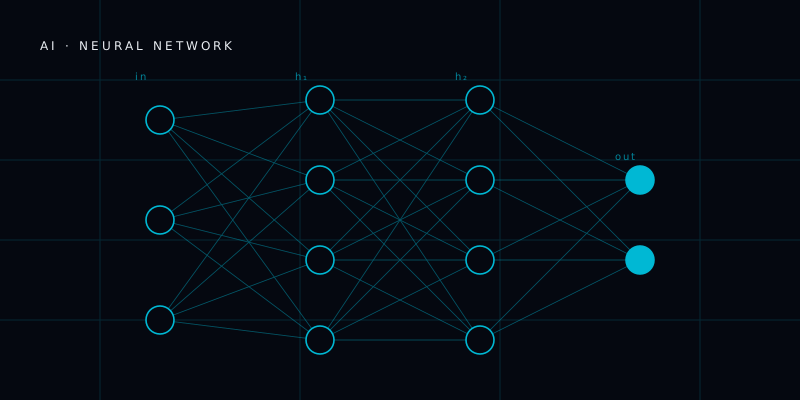
A neural network is a mathematical system loosely inspired by the brain, made of layers of simple calculations that together learn to recognise patterns — like faces, words, or sensor readings.
Imagine you are trying to teach a child to recognise a cat without ever writing down a rule. You show her a thousand photos: "cat," "not a cat," "cat." She doesn't memorise a checklist — she absorbs something vaguer and more powerful, a feeling for what cat-ness looks like. A neural network does something structurally similar, except instead of a child, it i
🇮🇳 In India
Niramai's breast-cancer screening, Sigtuple's blood-test AI, Tata Motors' visual quality inspection — all neural networks built in India.
🤯 A modern large neural network has more parameters than the human brain has synapses — but uses 100,000× less power.
🎯 Quick challenge
What is a neural network's smallest building block called?
Imagine you are trying to teach a child to recognise a cat without ever writing down a rule. You show her a thousand photos: "cat," "not a cat," "cat." She doesn't memorise a checklist — she absorbs something vaguer and more powerful, a feeling for what cat-ness looks like. A neural network does something structurally similar, except instead of a child, it is a chain of arithmetic operations, and instead of feelings, it is numbers.
That system is called a neural network — a collection of mathematical functions, arranged in layers, that learns to map inputs to outputs by adjusting millions of internal numbers called weights.
How it works
Each layer of a neural network is a set of neurons (also called nodes or units). A neuron does one thing: it takes several numbers in, multiplies each by a weight, adds them up, and passes the result through a simple squishing function. That is it. The power comes from stacking thousands of such neurons across dozens of layers.
During training, the network sees labelled examples. It makes a guess, compares it to the correct answer, measures how wrong it was, and nudges every weight slightly to make the next guess a little better. This process — called backpropagation — repeats millions of times until the network is reliably right.
A real example
The face unlock on a modern smartphone runs a neural network. It compares the infrared image of your face against a compressed mathematical signature it learned when you set up the device. The network was trained on millions of faces so it generalises — it still recognises you with a new haircut, in dim light, or wearing glasses.
Why it matters for robotics
A robot's sensors — cameras, microphones, lidar — produce raw streams of numbers that mean nothing on their own. Neural networks are the layer that turns those numbers into understanding: "this blob of pixels is a person," "this vibration pattern means the joint is slipping," "this voice command means pick up the red block." Without them, a robot is blind and deaf to meaning.
The deeper a neural network gets — the more layers it has — the more surprising and powerful the things it can learn, which is the story of deep learning.
Ask R2 Co-pilot anything you didn't understand about Neural network. It'll explain it plainly.
Learn this in the Academy
🔥F-03: Edge AI on Robots
Hands-on lesson · Forge track
Keep going
3D Gaussian Splatting
3D Gaussian splatting represents a scene as millions of tiny colored blobs, rendering photorealistic 3D in rea…
Concept6D Pose Estimation
6D pose estimation figures out an object's full position and orientation in 3D from a camera — not just where …
ConceptA* (A-Star) Pathfinding
A* finds the shortest path between two points on a grid or graph. It is the most-used pathfinding algorithm in…
Last updated · 2026-05-19
Community discussion
0 questions & insightsLoading discussion…
Spotted something off? Report an error →