Adaptive Control in Robotics
202 words · 2 min read · 1 source
Adaptive control automatically adjusts its parameters as the robot operates — handling changing payloads, friction, or environments without manual re-tuning.
Adaptive control is a class of controllers that update their own gains or model parameters in real time, in response to changes in the system being controlled. Where classical PID requires a human to retune when conditions change, adaptive control retunes itself.
What is it?
Adaptive control is a class of controllers that update their own gains or model parameters in real time, in response to changes in the system being controlled. Where classical PID requires a human to retune when conditions change, adaptive control retunes itself.
How it works
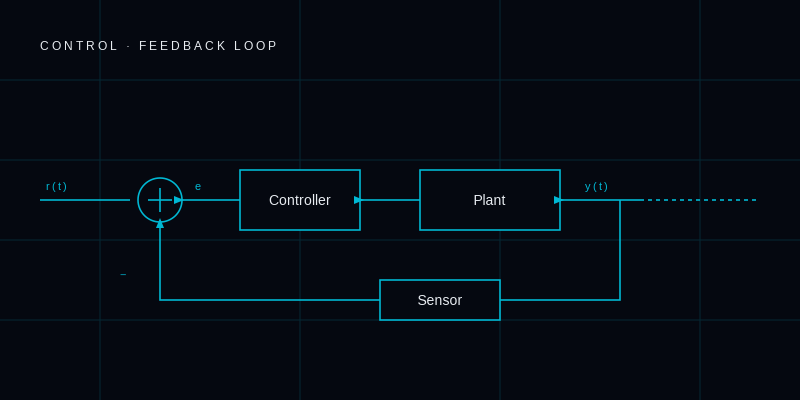
An adaptive controller couples a standard control law (e.g., PID or LQR) with a parameter-adjustment mechanism. The adjustment mechanism observes the tracking error and modifies the controller gains using a known update rule — for instance, the MIT rule or Model Reference Adaptive Control (MRAC). Over time, the gains converge to values appropriate for the current operating condition.
Real-world example
Aircraft autopilots use adaptive control to handle fuel burn-off changing aircraft weight. Robotic arms picking up unknown payloads use adaptive control to retune in real time. Tesla Autopilot's lane-keeping uses an adaptive component to handle different road surfaces.
Why it matters for robotics
Adaptive control is essential whenever conditions vary unpredictably. For real-world Indian robotics — where dust, humidity, and load vary daily — adaptive control is more practical than re-tuning PID gains every morning.
See also
Next: the course path
Five free courses, from zero to your own robot design
Short videos with a quiz after each one, a final activity and a certificate per course.
See the course path →Plain English. Free. Unsubscribe in one click.
Keep going
Feedback Loop in Robotics
A feedback loop continuously measures a robot's output and adjusts its input to reach a desired target. It is …
ConceptPID controller
A PID controller is a feedback algorithm that continuously corrects a robot's behaviour by measuring the gap b…
ConceptModel Predictive Control (MPC) in Robotics
MPC predicts future robot behaviour over a horizon and solves an optimisation problem to choose the best contr…
Last updated · 2026-05-21
Spotted something off? Report an error →