Deep learning
393 words · 2 min read · 2 sources
Deep learning is a branch of machine learning that stacks many layers of neural-network calculations on top of each other, allowing computers to learn complex skills — like understanding images or speech — directly from raw data.
For decades, teaching a computer to recognise a dog in a photo required a programmer to hand-write rules: look for fur texture, snout shape, four legs. The rules were brittle — they failed on dogs at odd angles, dogs in snow, dogs half-hidden behind furniture. Then researchers discovered that if you stack enough layers of simple maths, the computer writes it
🇮🇳 In India
Sarvam AI in Bengaluru built a deep-learning Indian-language model from scratch — Hindi, Tamil, Marathi all working at GPT-3.5 quality.
🤯 GPT-4 has ~1.8 trillion parameters. Training it cost more electricity than the city of Bengaluru uses in a day.
🎯 Quick challenge
What makes deep learning different from "shallow" machine learning?
For decades, teaching a computer to recognise a dog in a photo required a programmer to hand-write rules: look for fur texture, snout shape, four legs. The rules were brittle — they failed on dogs at odd angles, dogs in snow, dogs half-hidden behind furniture. Then researchers discovered that if you stack enough layers of simple maths, the computer writes its own rules, and those rules are much better than anything a human could craft.
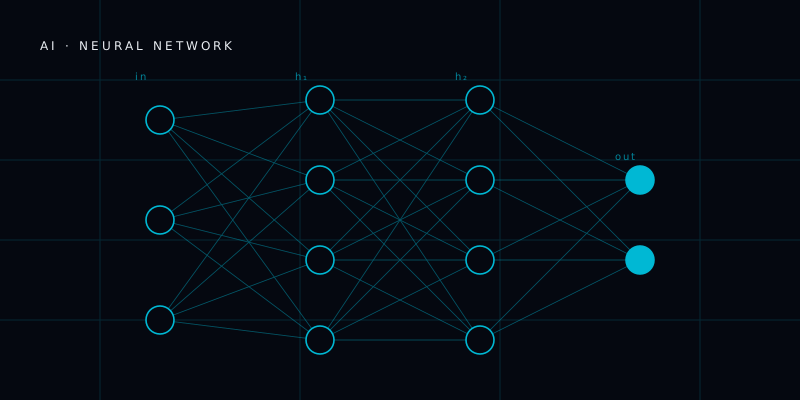
That approach is called deep learning — the "deep" refers to the depth of the network, meaning the number of layers stacked between input and output.
What depth buys you
A shallow network can learn simple patterns. Add more layers and each layer builds on the one before it, extracting progressively more abstract features. In a deep image-recognition network:
- Early layers detect edges and colour blobs.
- Middle layers detect textures, parts, and shapes.
- Deep layers detect full objects — faces, wheels, cups.
No programmer decided this structure. The network discovered it by itself during training.
The revolution it triggered
Deep learning is why voice assistants started working reliably around 2012, why photo apps can tag your friends automatically, and why self-driving cars can interpret a camera feed in real time. The breakthrough was partly theoretical and partly practical: researchers had the right architectures (deep convolutional networks, transformers), cheap GPU computing, and massive datasets, all arriving at roughly the same time.
Deep learning in robots
A robot vacuum that uses deep learning to identify cables on the floor (and navigate around them instead of getting tangled) is already in your home — the Roborock S8 MaxV does exactly this. Industrial robots use deep learning to inspect products on an assembly line for defects that are invisible to a rule-based system. Surgical robots use it to distinguish tissue types in real time.
The honest caveat
Deep learning requires enormous amounts of labelled training data and computing power. It can also fail in ways that are hard to predict — confidently misclassifying something a human would never mistake. Understanding why a deep network gives a particular answer is an active research problem. It is powerful and imperfect simultaneously.
Researchers are now asking whether the same deep-learning techniques that mastered vision and language can teach a robot hand the dexterity of a five-year-old child.
Ask R2 Co-pilot anything you didn't understand about Deep learning. It'll explain it plainly.
Keep going
3D Gaussian Splatting
3D Gaussian splatting represents a scene as millions of tiny colored blobs, rendering photorealistic 3D in rea…
Concept6D Pose Estimation
6D pose estimation figures out an object's full position and orientation in 3D from a camera — not just where …
ConceptA* (A-Star) Pathfinding
A* finds the shortest path between two points on a grid or graph. It is the most-used pathfinding algorithm in…
Last updated · 2026-05-19
Community discussion
0 questions & insightsLoading discussion…
Spotted something off? Report an error →