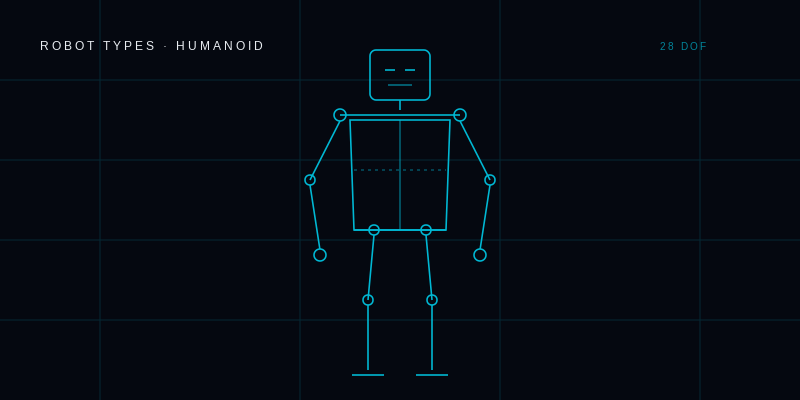
A bipedal robot is a robot that walks on two legs, like a person. Bipedal robotics is the field that designs, builds and controls these machines, and its central problem is balance: keeping a tall body upright on a small, constantly shifting footprint.
Stand on one leg and you will feel your ankle, knee and hip making constant tiny corrections to keep you upright. A two-legged robot has to do the same thing with motors and sensors. Most of the time it is not standing still at all: walking is a controlled fall forward, caught by the next step. Two legs are hard to master, but they let a robot use stairs, kerbs and narrow spaces built for people.
🎯 Quick challenge
What is the main difference between static and dynamic walking in a bipedal robot?
A bipedal robot is a robot that walks on two legs, like a person. Bipedal robotics is the field that designs, builds and controls these machines, and almost all of its difficulty comes down to one problem: keeping a tall body balanced on a support area no bigger than one or two feet, while that support keeps changing with every step.
Start here: why two legs are hard
Stand on one leg. Your ankle, knee, hip and trunk start making small corrections you never think about. Now picture a machine that weighs as much as an adult, carries its heaviest parts high up, and touches the ground with one foot at a time. It has to sense when it is tipping and react within a fraction of a second, every step, on every surface.
Wheels avoid all of this, which is why most robots use them. Engineers still build bipeds because the world is built for two legs: stairs, kerbs, ladders, narrow aisles, cluttered floors. A machine that walks like a person can, in principle, go where a person goes without the building being changed around it. That is also why most humanoid robots are bipeds.
How it works: from static to dynamic walking
Approach
Balance rule
What it looks like
Trade-off
Static walking
The centre of mass, projected onto the ground, always stays inside the support polygon (the area under and between the feet in contact)
Slow, careful steps; the robot could freeze mid-stride and not fall
Simple to control, very slow
Dynamic walking
The centre of mass may move outside the support area; flat-footed walkers keep the zero moment point inside it, while runners and point-footed robots balance by where they place the next foot
Smooth, human-like steps; each step catches a small forward fall
Faster and more efficient, needs fast sensing and control
Learned and whole-body control
A controller (optimised or trained) plans many steps ahead and uses the whole body, arms included
Running, recovering from pushes, uneven ground
Needs heavy computation or large-scale simulation
The zero moment point (ZMP) is the point on the ground where the contact forces under the feet produce no tipping moment. As long as that point stays inside the area the feet cover, the feet stay flat on the ground instead of rolling onto an edge, and that is the condition ZMP-based walking controllers plan around. The idea was introduced by Miomir Vukobratović and Davor Juričić in 1968 and became the standard tool for planning humanoid walking (Zero moment point; Kajita et al.).
One walking step, as a controller sees it
Dynamic walking is a loop that runs many times a second: measure the body's state, decide where the next foot must land, and move the joints so the robot keeps catching itself.
To plan steps quickly, controllers use simple stand-in models of the robot. The best known is the linear inverted pendulum: treat the whole robot as one mass on a massless leg, held at a constant height, so the equations become linear and can be solved in real time (Kajita et al., IROS 2001). A related idea, the capture point, answers a practical question: where must the robot step right now to come to a complete stop? It is the basis of many push-recovery controllers (Pratt et al., 2006).
Passive dynamics. In a 1990 paper, Tad McGeer showed that a carefully designed walking machine with no motors at all can walk down a gentle slope, powered only by gravity (McGeer, 1990). The lesson for later bipeds: let the legs swing naturally where possible instead of forcing every joint, and walking gets cheaper in energy.
Compliance. Springy legs and series elastic actuators store and return energy and absorb impacts, which matters most when running.
Optimisation and learning. Modern controllers use model predictive control to plan forces over the next second, or reinforcement learning policies trained in simulation and transferred to the real robot. Cassie's record run used a neural-network controller trained this way (robot profile).
Sensing. An IMU in the torso measures tilt and acceleration, joint encoders give the leg shape, and force sensors in the feet show where the centre of pressure is.
Why it matters
Two legs are the hardest way for a robot to move, and the most compatible with the places people live and work. Every advance in bipedal balance, from the ZMP to learned controllers, widens the set of buildings a robot can work in without anyone rebuilding them.
Common questions
What is bipedal robotics?
It is the branch of robotics that builds and controls robots that walk on two legs. Its core problems are balance, footstep planning and handling uneven ground, pushes and slips.
Why don't most robots walk on two legs?
Wheels and four legs are more stable and cheaper to control. Two legs are chosen when a robot must work in spaces built for people, such as stairs and narrow aisles.
What is the difference between a bipedal robot and a humanoid robot?
"Bipedal" describes how a robot moves: on two legs. "Humanoid" describes its overall shape: a human-like body, usually with arms and a head. Most humanoids are bipeds, but a biped such as Cassie has no upper body at all, and some humanoids, such as Pepper, roll on wheels.