Push recovery is how a legged robot keeps its balance when shoved — the ankle, hip, and stepping reflexes that let a humanoid take a hit and stay upright instead of toppling.
Push recovery is a robot's version of catching your balance when someone bumps you. Depending on how hard the push is, it flexes its ankles, bends at the hips, or takes a quick step — the same instincts people use.
🎯 Quick challenge
For a large shove, a robot's most effective push-recovery strategy is usually to…
Shove a standing person and they instinctively flex, sway, or step to stay up. Giving a robot those same reflexes is push recovery — and it's what separates a humanoid that survives the real world from one that topples at the first bump.
The three strategies
Just like humans, robots reject disturbances with an escalating set of strategies, chosen by how big the push is:
Ankle strategy — for a small push, tilt at the ankles to shift the ground reaction and nudge the body back upright. Keeps the feet planted.
Hip strategy — for a medium push, rapidly bend at the hips/torso, using the body's angular momentum to recover. Feet still planted.
Stepping strategy — for a large push, when the first two can't cope, take a quick step to a new base of support — the robot's version of catching yourself.
Escalating balance reflexes
The controller picks the least drastic strategy that will work: flex the ankles, then the hips, and only step when it must.
The key idea: where to step
When stepping is needed, where to plant the foot is critical — step short and you keep falling; step right and you stop. That target is the capture point: the spot where planting the foot arrests the robot's momentum and brings it to rest. Push recovery is largely the practical application of capture-point (and ZMP) theory, executed through whole-body control so the whole robot cooperates in the save.
Why it's hard
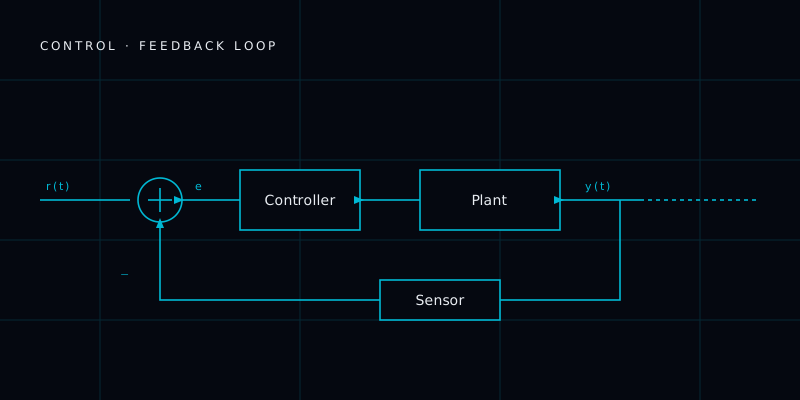
The robot must sense the disturbance fast (via IMU and force sensing), decide which strategy in milliseconds, and execute a coordinated whole-body response — all before it passes the point of no return. It's a fast, high-stakes control problem, and robust push recovery on rough ground is still an active research frontier.
Why it matters
Push recovery is what makes legged robots trustworthy around people and in the messy real world, where bumps, slips, and uneven ground are inevitable. Those viral clips of humanoids taking a shove and striding on are push recovery at work — a hallmark of mature balance control.