Arduino-Based Robot Control
186 words · 1 min read · 1 source
Arduino boards are the most common microcontroller platform for beginner robotics. They handle sensors, motor control, and PID with just a few lines of code.
Arduino is an open-source electronics platform built around easy-to-use ATmega and ESP-based microcontrollers. In robotics, an Arduino board acts as the brain — reading sensors, running control logic, and driving actuators.
What is it?
Arduino is an open-source electronics platform built around easy-to-use ATmega and ESP-based microcontrollers. In robotics, an Arduino board acts as the brain — reading sensors, running control logic, and driving actuators.
How it works
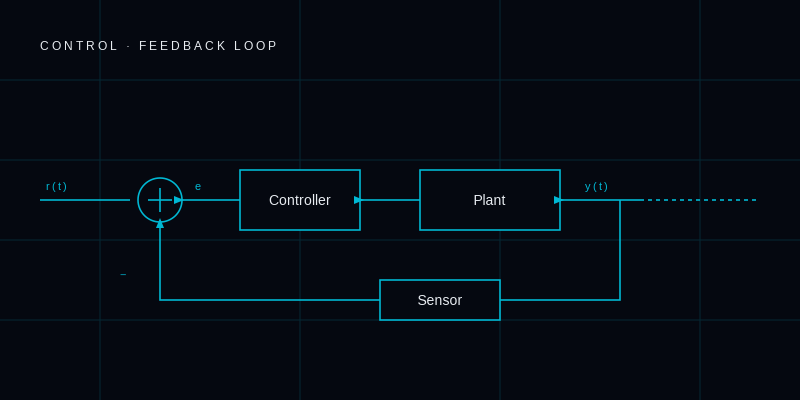
An Arduino executes a setup() function once at boot and then loops the loop() function continuously. Within loop(), the program reads analog and digital pins (sensors), computes control commands (e.g., PID error correction), and writes outputs to PWM and digital pins (motors, LEDs, relays). The Arduino IDE compiles C++ code and uploads it over USB to the board.
Real-world example
Indian school robotics teams almost always start with Arduino Uno. Line-follower, obstacle-avoidance, and balancing robots are all classic Arduino projects. NASA-affiliated school programmes worldwide use Arduino because it's cheap and accessible.
Why it matters for robotics
Arduino is the universal entry point to embedded robotics. Every Indian engineering college teaches Arduino in lab sessions. Mastering Arduino unlocks the path to ESP32, STM32, and finally ROS2-grade microcontrollers like the Teensy 4.1.
See also
Next: the course path
Five free courses, from zero to your own robot design
Short videos with a quiz after each one, a final activity and a certificate per course.
See the course path →Plain English. Free. Unsubscribe in one click.
Keep going
Microcontroller
A microcontroller is a tiny self-contained computer — processor, memory, and input/output pins all on a single…
ConceptPID controller
A PID controller is a feedback algorithm that continuously corrects a robot's behaviour by measuring the gap b…
ConceptPWM (Pulse Width Modulation)
PWM is a trick for making a digital chip — which can only turn things fully on or fully off — behave as if it'…
Last updated · 2026-05-21
Spotted something off? Report an error →