Quadrotor dynamics explain how a four-rotor drone flies — how varying four propeller speeds produces thrust, tilt, and turn — and why a drone is inherently unstable and must be controlled hundreds of times a second.
A quadrotor flies by spinning four propellers. Speeding some up and slowing others tilts it, and tilting is how it moves. It can't balance itself, so an onboard computer adjusts all four motors hundreds of times a second to keep it steady.
A quadrotor looks simple — four propellers on an X — but flying it is a genuine control challenge. Understanding quadrotor dynamics is understanding why a drone can't fly itself and what its flight controller is constantly doing.
How four rotors control flight
Each of the four fixed rotors only points up and only spins. Yet by varying their relative speeds, the drone controls all its motion:
Thrust (up/down) — speed all four up or down together.
Roll / Pitch (tilt) — speed up the rotors on one side and slow the opposite side; the drone tilts, and the tilted thrust pushes it sideways. Tilting is how a quadrotor moves horizontally — it has no separate way to go sideways.
Yaw (turn) — adjacent rotors spin opposite directions; speeding up one diagonal pair over the other creates a net twist that rotates the drone.
Four motor speeds → all motion
Four inputs produce lift plus three rotational torques. To move sideways the drone must first tilt — thrust and direction are coupled.
Why it's inherently unstable
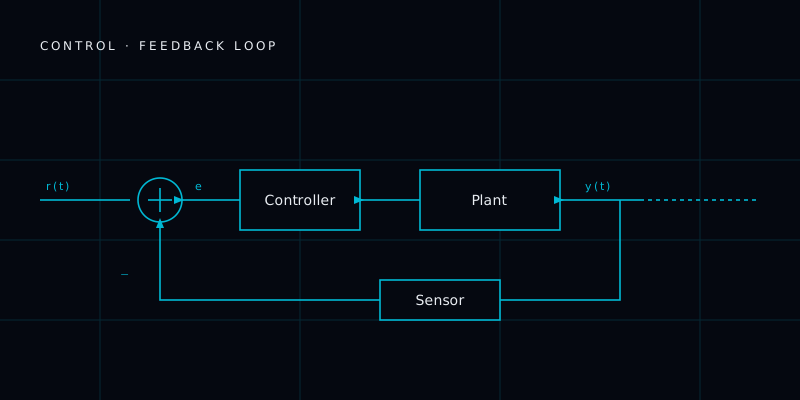
A quadrotor is underactuated (four motors, six degrees of freedom) and naturally unstable — left alone it tips and tumbles, because there's nothing passively keeping it level. It stays airborne only because a controller reads the IMU (attitude and angular rate) and adjusts the four motors — via ESCs — hundreds of times per second, typically with nested PID loops (an inner fast loop on angular rate, an outer loop on attitude and position).
What follows from the dynamics
Coupling. Because moving requires tilting, position and attitude control are linked — you can't accelerate forward without pitching.
Agility. Small, light quadrotors have low rotational inertia, enabling the aggressive flips and racing maneuvers drones are known for.
Wind and disturbance. The fast inner loop is what rejects gusts and keeps a hover rock-steady.
Why it matters
Quadrotor dynamics are the foundation of drone flight control — they explain the coupling between tilt and motion, the need for high-rate stabilization, and why a flight controller is doing constant, invisible work. They're essential to anyone building, tuning, or programming multirotors.