A central pattern generator is a network of coupled oscillators that produces rhythmic motion — the biology-inspired engine that gives legged and swimming robots smooth, self-sustaining gaits without scripting every joint move.
A central pattern generator is a small "rhythm circuit" that produces repeating up-down signals on its own, like a heartbeat. Feed those to a robot's legs and it walks in a steady rhythm, without a controller planning every single step.
Animals don't consciously plan each step — a rhythmic circuit in the spinal cord keeps their legs cycling. Robots can borrow that trick with a central pattern generator.
The biological idea
In animals, central pattern generators are neural circuits that produce rhythmic muscle activity without needing rhythmic input — the source of walking, swimming, and breathing rhythms. A cat with its brain disconnected can still produce stepping patterns, because the CPG in its spinal cord generates them locally.
The robot version
A robotic CPG is a network of coupled oscillators — small mathematical units that each output a repeating up-and-down signal, linked so they stay in a fixed phase relationship. Wire each oscillator to a leg (or body segment) and the network produces a coordinated, self-sustaining gait.
Coupled oscillators make a gait
The oscillators lock into a stable phase pattern, so the legs cycle in coordination automatically — no step-by-step planning of each joint.
Why it's useful
Self-sustaining rhythm. The gait keeps going on its own; you don't script every joint angle over time.
Smooth transitions. Slowly change the oscillators' frequency or coupling and the gait morphs smoothly — speeding up, or shifting from walk to trot — without discontinuities.
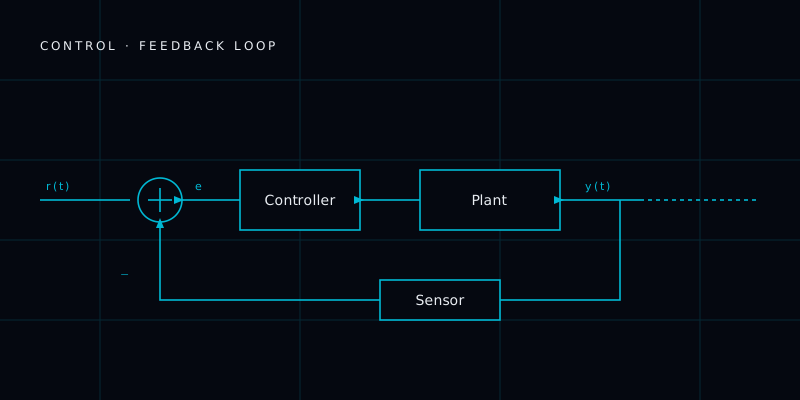
Robustness and feedback. Sensory feedback (foot contact, body tilt) can nudge the oscillators, so the gait adapts to disturbances and terrain, entraining to the body's dynamics.
Few parameters. A whole gait is controlled by a handful of numbers (frequency, amplitude, phase), which is also friendly to optimization and learning.
Where you'll see it
Quadruped and hexapod walkers, salamander and snake robots, swimming and eel-like robots (where the traveling-wave gait is naturally a CPG), and as a low-level layer beneath higher planners. It competes with — and is sometimes combined with — model-based and learned gait controllers.
Why it matters
The central pattern generator brings biology's elegant solution for rhythmic motion into robotics: coordinated, adaptable gaits from a compact, self-sustaining rhythm engine. It's a foundational idea in bio-inspired locomotion.