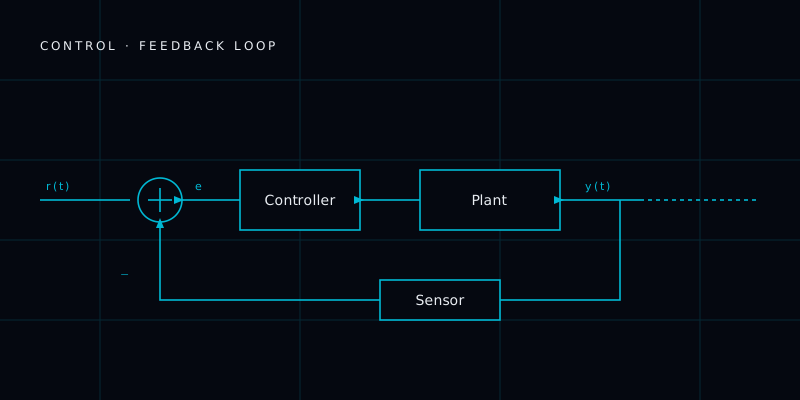
Trajectory optimization computes a robot's motion by minimizing a cost — smoothness, effort, time — subject to physics and constraints, producing efficient, dynamically-feasible motions for arms, legs, and vehicles.
Trajectory optimization finds the best way for a robot to move by treating the whole motion as a math problem: minimize things you don't want (jerkiness, wasted effort, time) while obeying the rules (physics, joint limits, no collisions). The solver returns a smooth, efficient motion.
Sampling planners like RRTfind a path; trajectory optimization computes the best motion — smooth, efficient, and physically feasible — by treating the whole trajectory as a math problem to solve.
The idea
Trajectory optimization poses motion as a constrained optimization: find the trajectory (positions, velocities, and controls over time) that minimizes a cost while satisfying constraints.
Cost — what you want to minimize: jerkiness (for smoothness), control effort/energy, time, distance, or deviation from a reference.
Constraints — what must hold: the robot's dynamics (it must obey physics), actuator limits (torque, velocity), joint limits, and collision avoidance (stay clear of obstacles).
A numerical solver then computes the trajectory that best balances these — the output is a ready-to-execute, dynamically-feasible motion.
Motion as an optimization
Rather than search discrete options, it directly optimizes the continuous trajectory to be as good as possible while obeying every physical rule.
Why it's powerful
Quality. Produces genuinely smooth, efficient motions — not just feasible ones — respecting the robot's dynamics, which sampling planners often ignore.
Rich constraints. Naturally handles torque limits, contact, balance, and multiple objectives at once — essential for legged robots and dexterous arms.
Foundation of modern control.Model predictive control is trajectory optimization solved repeatedly over a rolling horizon, and whole-body controllers are optimization at heart.
Methods include CHOMP and TrajOpt (optimize a motion for a manipulator away from collisions), direct collocation, and shooting methods.
The trade-offs
Local minima. Optimizers can get stuck in a poor local solution; a good initial guess (sometimes from a sampling planner) matters. A common hybrid: RRT to find a feasible path, then optimize it to smooth and improve it.
Compute. Solving can be expensive, though modern solvers and warm-starting make real-time use possible (as in MPC).
Non-convexity. Collision and dynamics constraints make the problem hard; robust formulations are an active area.
Why it matters
Trajectory optimization is how robots compute high-quality, physically-realistic motion — the mathematical engine behind smooth manipulation, agile legged locomotion, aggressive drone flight, and predictive control. It's a central, unifying tool linking planning and control in modern robotics.