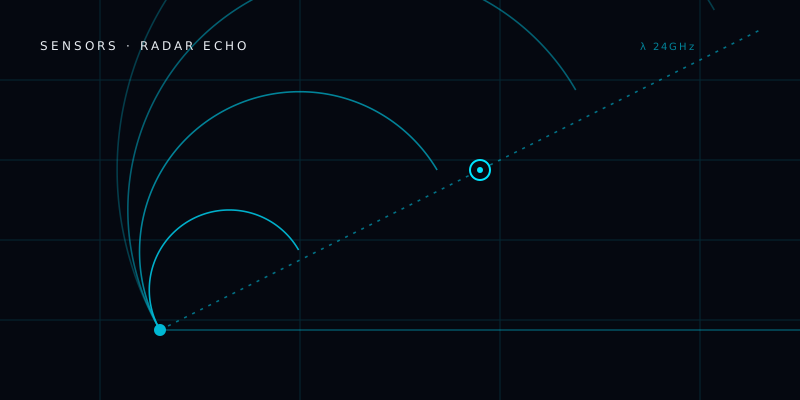
A time-of-flight sensor measures distance by timing how long light takes to bounce back — the compact ranging tech behind depth cameras, phone face-unlock, and short-range robot obstacle detection.
A time-of-flight sensor sends out a pulse of light and measures how long it takes to come back. Since light travels at a known speed, that time tells it the distance to whatever it hit.
The most direct way to measure distance is to bounce something off a target and time the echo. Do it with light and you have a time-of-flight (ToF) sensor — the compact ranging technology now inside phones, depth cameras, and small robots.
How it works
The sensor emits a pulse or modulated beam of (usually infrared) light, and measures how long it takes to reflect back. Since light travels at a known, constant speed, the round-trip time gives the distance directly:
distance = (speed of light × round-trip time) / 2
Cheaper single-point ToF sensors time a pulse; ToF cameras measure the phase shift of modulated light across a whole sensor array, producing a depth value for every pixel at once.
Distance from the speed of light
Because light's speed is fixed, timing the round trip yields distance. A full array of these gives a live depth image.
ToF vs its cousins
LiDAR is essentially ToF scaled up — often the same principle, but longer range, scanning across a scene, and higher precision. Short-range ToF chips are the cheap, solid-state end of the family.
Structured light projects a pattern instead of timing light — better at very close range and fine detail, but shorter range and worse in sunlight.
Ultrasonic does the same timing trick with sound — cheaper and works on glass, but coarse and slow.
Where you'll see it
Phone face-unlock and portrait-mode depth, depth cameras (the Kinect Azure and many RealSense units are ToF), drone altitude and obstacle sensing, robot vacuum cliff/obstacle detection, and gesture interfaces. Its appeal is being tiny, solid-state, and fast — a whole depth camera on a chip.
The limits
Bright sunlight can swamp the returning signal; highly reflective, dark, or transparent surfaces confuse it; and multiple ToF sensors can interfere with each other. Range is modest (centimeters to a few meters for the small ones).
Why it matters
Time-of-flight sensing put depth perception into a cheap, compact package, bringing 3D sensing to phones and small robots. Understanding it clarifies the whole family of active depth sensors, LiDAR included.