Service robot
465 words · 3 min read · 2 sources
A service robot is any robot that performs tasks useful to humans outside of industrial manufacturing — in places like hospitals, hotels, homes, and public spaces — operating with varying degrees of autonomy.
When you walk into a hotel lobby and a small robot rolls over to hand you a towel, or when a robot mops the floor of a shopping mall in quiet circles at midnight, or when a machine in a hospital automatically delivers medications to the right ward — you are watching a service robot at work.
When you walk into a hotel lobby and a small robot rolls over to hand you a towel, or when a robot mops the floor of a shopping mall in quiet circles at midnight, or when a machine in a hospital automatically delivers medications to the right ward — you are watching a service robot at work.
Service robots are everywhere, and most people have not registered them as robots at all.
What makes a robot a "service" robot
The International Federation of Robotics (IFR) defines a service robot as a robot that performs useful tasks for humans or equipment, excluding industrial manufacturing. It is fundamentally a catch-all category: if a robot is not welding, stamping, or painting in a factory, it is probably a service robot.
The category splits into two broad groups. Professional service robots operate in commercial settings — cleaning airports, transporting meals in hospitals, patrolling warehouses for security, disinfecting hotel rooms with UV light. Personal service robots are designed for private use — robotic vacuum cleaners, lawn mowers, educational companions, and assistive robots for elderly or disabled people.
The huge range of what they do
Service robots operate in wildly different environments and perform tasks with very different technical demands:
- A robotic lawnmower (Husqvarna Automower) navigates a garden with a buried wire boundary and avoids obstacles. Simple, reliable, and commercially mature.
- A hospital logistics robot (Aethon TUG, now Vecna Robotics) maps a hospital, takes lifts, and delivers medications, linens, and meals autonomously — navigating around patients and staff.
- A telepresence robot (Double Robotics) is a screen on a wheeled stand, letting a remote person "be present" and move around an office.
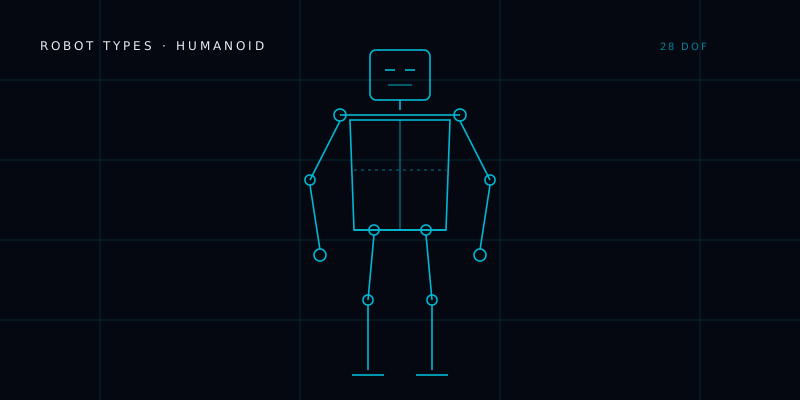
- A humanoid service robot (Pepper, by SoftBank Robotics) holds conversations, reads facial expressions, and greets customers in retail or hospitality settings — though its practical usefulness beyond novelty remains debated.
A real example
Keenon's DINERBOT T8 has been deployed in thousands of restaurants across Asia, delivering food from kitchen to table on multiple trays simultaneously. It navigates crowded dining rooms, announces its arrival, and returns autonomously to the kitchen for the next load. Chains in China, Singapore, and increasingly Europe now run restaurants where no human waiter carries food. The robot does not take orders or interact conversationally — it simply moves plates accurately and reliably.
The limits of service robots today
Most commercial service robots are good at one narrow task in one carefully mapped environment. They struggle when that environment changes — furniture rearranged, a new crowd configuration, an unexpected door. True general-purpose service robots that handle diverse tasks fluidly are still a research frontier, not a product you can buy.
The domestic robot vacuum — boring, reliable, bought by millions — may be teaching more AI researchers about real-world navigation than any laboratory experiment.
Ask R2 Co-pilot anything you didn't understand about Service robot. It'll explain it plainly.
Keep going
3D Gaussian Splatting
3D Gaussian splatting represents a scene as millions of tiny colored blobs, rendering photorealistic 3D in rea…
Concept6D Pose Estimation
6D pose estimation figures out an object's full position and orientation in 3D from a camera — not just where …
ConceptA* (A-Star) Pathfinding
A* finds the shortest path between two points on a grid or graph. It is the most-used pathfinding algorithm in…
Last updated · 2026-05-19
Community discussion
0 questions & insightsLoading discussion…
Spotted something off? Report an error →