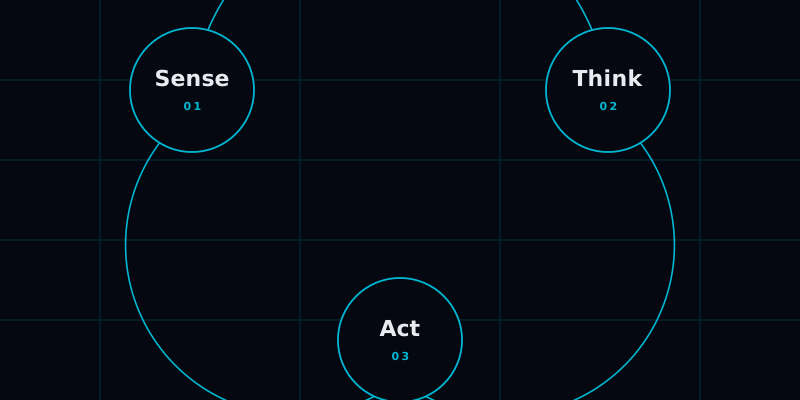
Sense-Think-Act loop
540 words · 3 min read · 2 sources
The Sense-Think-Act loop is the repeating cycle at the heart of every robot — gather information from the environment, process it, then do something physical. Everything a robot does traces back to this three-step rhythm.
Watch a goalkeeper save a penalty kick. Their eyes track the ball the moment the striker's foot makes contact — that is sensing. Their brain predicts where the ball is going in a fraction of a second — that is thinking. Their legs and arms dive to intercept — that is acting. And then instantly the loop starts again: where is the ball now? Do I still have it?
Watch a goalkeeper save a penalty kick. Their eyes track the ball the moment the striker's foot makes contact — that is sensing. Their brain predicts where the ball is going in a fraction of a second — that is thinking. Their legs and arms dive to intercept — that is acting. And then instantly the loop starts again: where is the ball now? Do I still have it? Should I roll it out or punch it away?
Every robot, from a wheeled toy to a Mars rover, runs this same cycle. It is called the Sense-Think-Act loop (sometimes Perceive-Plan-Act or Observe-Orient-Decide-Act in military robotics). The names differ; the structure does not.
What each stage actually does
Sense is the robot gathering raw data from its environment. A camera produces an image. A lidar fires laser pulses and measures how long they take to return. A force sensor in a joint detects if the arm has hit something. The output of sensing is data — numbers, images, signals — that tell the robot something about the state of the world right now.
Think is the robot processing that data into a decision. Depending on the robot's sophistication, this might be a simple rule ("if distance to wall < 20 cm, turn left") or a complex probabilistic model that fuses a dozen sensor streams, estimates its own position in a map, and plans a path through a cluttered room. In modern robots, the "thinking" step increasingly involves neural networks trained on millions of examples.
Act is the robot sending commands to its actuators — motors, pneumatic pistons, servos — that produce motion or force in the physical world. "Act" always has a consequence: something moves, something changes.
How fast the loop runs
A warehouse sorting robot might complete this loop 50 times per second. A spacecraft doing orbital manoeuvres might complete it once every few minutes. The frequency depends on how fast the world changes and how quickly the robot must respond. A robot doing open-heart surgery needs a faster loop than one that waters plants on a schedule.
When a loop is too slow for the task — when the "think" step takes longer than the environment is willing to wait — bad things happen. An autonomous car that takes 200 milliseconds to process a camera frame will have driven two metres blind at motorway speed. Matching loop speed to task requirements is a core challenge in robotics system design.
Why everything else depends on it
Strip away all the complexity from any robotic system and you find this loop underneath. Sensors, actuators, processors, control algorithms, machine-learning models — all of these are implementations of one of the three stages. When a robot fails, the failure almost always lives in one stage: a sensor that misreads, a planner that makes the wrong decision, an actuator that doesn't respond correctly. Tracing problems back to their stage in the loop is the first step in debugging any robotic system.
What happens when the "think" step is so slow that the world has changed by the time the robot acts — and how do the most capable autonomous systems work around that fundamental constraint?
Ask R2 Co-pilot anything you didn't understand about Sense-Think-Act loop. It'll explain it plainly.
The loop, animated
Keep going
3D Gaussian Splatting
3D Gaussian splatting represents a scene as millions of tiny colored blobs, rendering photorealistic 3D in rea…
Concept6D Pose Estimation
6D pose estimation figures out an object's full position and orientation in 3D from a camera — not just where …
ConceptA* (A-Star) Pathfinding
A* finds the shortest path between two points on a grid or graph. It is the most-used pathfinding algorithm in…
Last updated · 2026-05-19
Community discussion
0 questions & insightsLoading discussion…
Spotted something off? Report an error →