A NeRF learns a 3D scene from a set of photos by training a neural network to render it from any viewpoint — a breakthrough in 3D reconstruction now being used to build rich maps and simulators for robots.
A NeRF takes a bunch of photos of a scene and trains a small neural network to recreate that scene in 3D, so you can view it from angles you never photographed. It produces stunningly realistic 3D reconstructions from ordinary pictures.
In 2020, a surprising idea reshaped 3D reconstruction: represent a whole scene as a neural network you can render from any angle. That's a NeRF, and it's making its way into how robots build and use 3D worlds.
The idea
A NeRF (Neural Radiance Field) trains a small neural network to answer one question: for any 3D point, looked at from any direction, what color is it and how solid is it? Feed it many photos of a scene (with known camera poses, from structure from motion) and it learns a continuous radiance field. To make an image from a new viewpoint, you shoot rays into the field and integrate color and density along them (volumetric rendering) — producing photorealistic views of angles you never captured.
Photos in, any view out
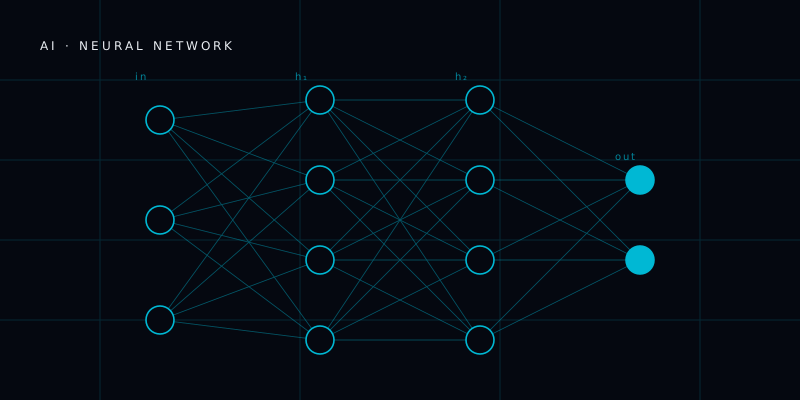
The scene lives inside a neural network as a continuous field; new images are synthesized by integrating along rays — reconstruction as a learned function.
Why it caused excitement
Photorealism from photos. Stunning reconstructions of real scenes and objects from ordinary images, capturing fine detail, reflections, and view-dependent effects that mesh-based methods miss.
Continuous and compact. The scene is a smooth function, not a discrete mesh or point cloud.
A new representation. It reframed 3D as something you learn and render, sparking a huge research wave.
Relevance to robots
Rich 3D maps and digital twins. Reconstructing environments in high fidelity for planning, inspection, and visualization.
Synthetic data and simulation. Rendering realistic novel views to train and test perception — bridging toward realistic simulators of real places.
Object reconstruction for manipulation and recognition.
The catch — and what came next
Original NeRFs were slow to train and render, unfit for real-time robotics. Faster variants (Instant-NGP) cut training to seconds/minutes. But the bigger shift is 3D Gaussian Splatting, which achieves comparable quality with real-time rendering, and is rapidly becoming the practical choice — while NeRF remains the conceptual breakthrough that started it.
Why it matters
NeRF changed how the field thinks about 3D — as a learnable, renderable field rather than explicit geometry. For robotics, it and its successors point toward rich, photorealistic 3D maps and simulators built from ordinary images, a powerful new tool for perception, mapping, and sim-to-real.