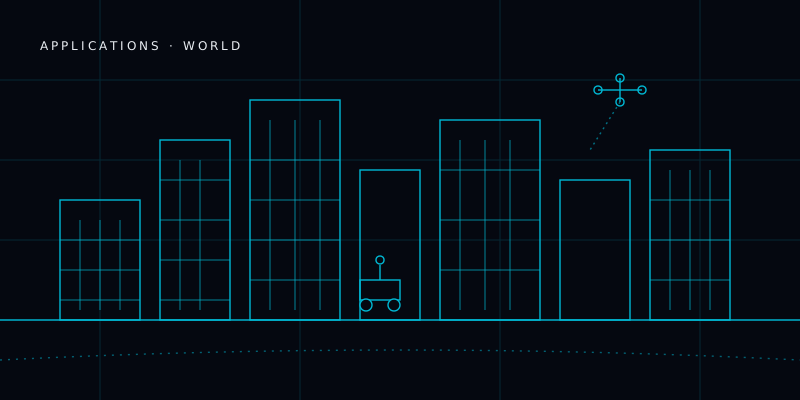
Last-mile delivery robots carry packages and food the final stretch to your door — small sidewalk rovers and drones tackling the most expensive, hardest-to-automate leg of the supply chain.
Last-mile delivery robots are the little sidewalk carts and drones that bring your food or parcel the last stretch from a local hub to your door — automating the final, priciest step of delivery.
🎯 Quick challenge
Why is the 'last mile' targeted for robot automation?
Goods travel efficiently across the world by ship and truck — until the very end. That final stretch to each individual doorstep, the "last mile," is shockingly expensive, and it's the target of a wave of delivery robots.
Why the last mile is the hard, costly part
Long-haul transport is cheap per package because it moves in bulk. But the last mile — delivering to each separate address — can be a large share of total delivery cost: many stops, low volume per stop, traffic, and human labor. Automating it promises major savings, which is why so many companies chase it.
The final leg to your door
Bulk transport gets goods to a nearby hub cheaply; the robot automates the costly final leg to each individual door.
The two main forms
Sidewalk rovers — small, slow, cooler-sized wheeled robots (Starship, Serve) that trundle along footpaths carrying food or parcels. They navigate with SLAM, cameras, and GPS, cross streets carefully, and often have remote human oversight for tricky moments.
Delivery drones — aerial delivery (Wing, Zipline) that flies over traffic entirely, excellent for speed and for reaching remote or hard-to-drive areas (Zipline's medical deliveries in Rwanda are a landmark).
Unstructured public space. Sidewalks and airspace are shared with pedestrians, pets, cyclists, and weather — far messier than a warehouse.
Edge cases everywhere. Curbs, crosswalks, construction, doorways, apartment buildings — the "long tail" of situations is enormous.
Regulation and public acceptance. Operating on public paths and airspace needs permissions and community trust.
Security and the final handoff. Preventing theft and actually getting the item to the right person.
Because of the long tail, many deployments keep a human in the loop for supervision.
Why it matters
Last-mile delivery robots push autonomy out of controlled facilities and into the chaotic real world — arguably the hardest test of mobile robotics. Success would reshape logistics economics and is already improving access to goods and medicine in places trucks struggle to reach.