Buoyancy control lets an underwater robot rise, sink, and hover by adjusting its effective density — the depth-keeping mechanism behind AUVs, gliders, and any robot that works beneath the surface.
Buoyancy control is how an underwater robot decides to float up, sink down, or hang still. By changing how much it weighs relative to the water it displaces — like a fish's swim bladder — it controls its depth.
On land, gravity pins a robot down; in the air, a drone fights gravity constantly. Underwater, there's a third option — buoyancy — and controlling it is how a submarine robot manages its depth.
The physics
Any submerged body feels two vertical forces: its weight pulling down, and the buoyant force (the upthrust from the water it displaces) pushing up. Their balance — the net buoyancy — decides everything:
Weight > buoyancy → negative → the robot sinks.
Buoyancy > weight → positive → the robot rises.
Equal → neutral → the robot hovers at depth.
Buoyancy control is the act of tuning that balance to go up, down, or hold station — exactly what a fish does with its swim bladder.
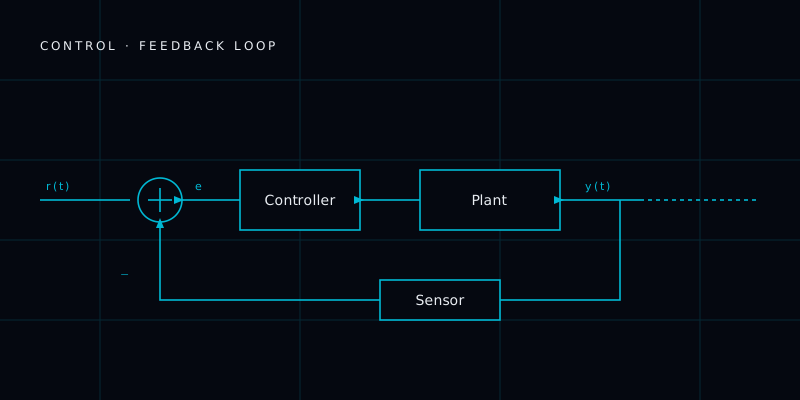
Depth from the weight–buoyancy balance
Adjust how much water the robot effectively displaces (or its ballast), and net buoyancy — and therefore vertical motion — follows.
How robots do it
Ballast tanks — flood with water to sink, blow out with air to rise (the classic submarine method).
Variable-buoyancy engines — pump oil between an internal reservoir and an external bladder to change displaced volume slightly. Efficient and precise, used by underwater gliders that sawtooth up and down across whole oceans on tiny power.
Thrusters — vertical props actively hold depth; simple and responsive but power-hungry, common on hovering ROVs.
Why it matters for underwater robots
Endurance. Buoyancy-driven gliders barely use energy to change depth, enabling months-long missions — a huge advantage where recharging is impossible.
Stable operation. Achieving neutral buoyancy lets an AUV hover to inspect or sample without wasting thrust.
Safety. A well-designed vehicle is set slightly positive so it floats to the surface if power fails.
Depth control pairs with pressure sensors, and since GPS doesn't work underwater, navigation leans on dead reckoning and sensor fusion.
Why it matters
Buoyancy control is the defining locomotion problem of underwater robotics — the equivalent of thrust for a drone or wheels for a rover. Mastering it is what lets robots explore, monitor, and work in the ocean, efficiently and for a long time.